
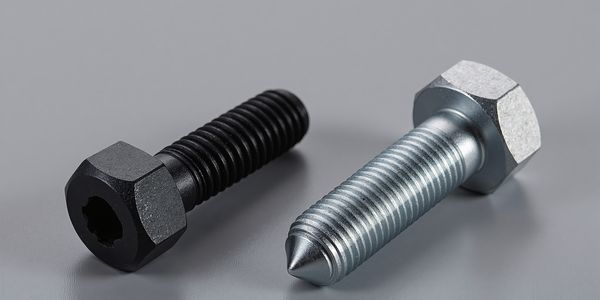
At a glance
Read bolt strength markings, compare nominal values, and prepare a specification that covers the complete joint.
How to read the marking
For carbon and alloy steel bolts, the first number multiplied by 100 gives nominal tensile strength in MPa. The second number divided by 10 gives the nominal yield-to-tensile ratio. Class 8.8 therefore represents 800 MPa nominal tensile strength and a nominal ratio of 0.8.
These numbers explain the designation; they are not a complete acceptance specification. Required minimum properties and test methods depend on the applicable standard, diameter and product geometry.
Compare nominal values
Use this table to understand markings, not to calculate a safe working load or an installation torque. MPa is equivalent to N/mm².
| Property Class | Nominal tensile strength (MPa) | Nominal yield ratio |
|---|---|---|
| 4.6 | 400 | 0.6 |
| 8.8 | 800 | 0.8 |
| 10.9 | 1000 | 0.9 |
| 12.9 | 1200 | 0.9 |
Choose for the complete joint
A higher class is not automatically a better replacement. Check the specified preload, mating nut, washer, thread engagement, coating and service environment together. Changing the lubricant or finish can change the torque needed to achieve the intended clamp force.
Low and countersunk heads may have reduced loadability. For a countersunk socket screw, check its product standard as well as its property class before applying data from a conventional hex bolt.
What to include in your RFQ
State the product standard, thread diameter and pitch, length, property class, finish and quantity. Include the drawing revision and required inspection documents. If replacing an existing fastener, provide its markings and assembly requirements rather than relying on a photograph alone.
Technical references
Ready to specify your fasteners?
Send your drawing and requirements to start a quotation.